

Perth was treated to a match that captured the essence of Twenty20 after a three-year absence from international cricket. As control shifted wildly between the sides, there were more than 400 runs as well as a dash of controversy. Sam Curran used his arsenal of variations to protect 16 from the final over, giving England the tremendous delight of an eight-run victory to celebrate.
However, there were numerous instances in the closing minutes when the outcome of the game at Optus Stadium threatened to change. When Mark Wood removed Australia’s two local big hitters, Marcus Stoinis and Tim David, in the 15th over, the run chase assumed a different tone as Australia waltzed toward their mark of 209. When David Warner, whose 73 had kept Australia’s innings together, was taken out by Wood later in the same over with a short, quick delivery, it appeared to herald England’s victory. Wood’s spell of three wickets for four runs in 11 balls was a reminder of the indispensible importance of pace in T20.
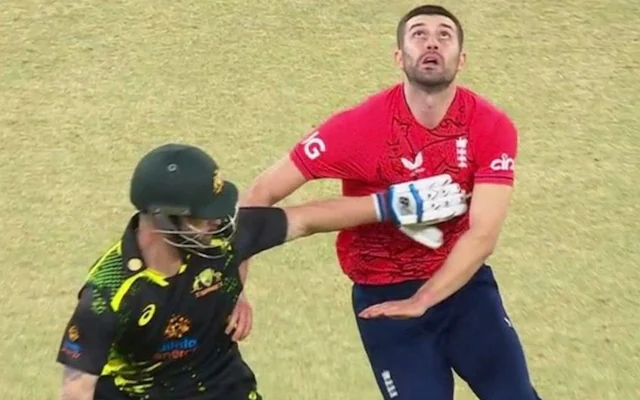
Instead, Matthew Wade continued the challenge set by the hosts with a little help from the visitors. Wade scrambled back to his crease as his top edge looped up after being troubled by a Wood short delivery, but his extended left arm appeared to prevent the bowler from taking the catch. Wade received a concussion test, but England decided not to challenge.
When asked if he would have made a different choice if these teams had met again in three weeks at the T20 World Cup, skipper Jos Buttler smiled and responded, “Maybe, yeah.” “I had no idea what had transpired. When they asked if I wanted to appeal, I responded, “We’ve been in Australia for a while.”
So much for the trepidation that so frequently precedes English cricket travels to Australia; after being given the opportunity to bat, Buttler crushed four drives in the first over as Cameron Green suffered from overpitching. His performance made no mention of the calf issue that had prevented him from playing in Pakistan’s seven T20 matches. Pat Cummins, Josh Hazlewood, and Mitchell Starc were all rested but will be back in Canberra on Wednesday, so Buttler won’t often face such friendly Australian attacks. However, the inventiveness and vigour of his 68 reminded me of his four centuries from the previous Indian Premier League.
Buttler scooped fine leg over the guy when Kane Richardson brought him up for four; on the subsequent delivery, with fine leg now back, another scoop—straighter and more powerful—went for six.
The conclusion of the Powerplay typically signals the beginning of a lull. However, after the fielding limitations were lifted, Buttler smashed the following two balls from leg spinner Mitchell Swepson for six.
Although Buttler’s range is unmatched in the England team, his opening partner Alex Hales came very close to matching it. Hales and Buttler had not batted together in a game since 2018; their partnership of 132 runs in 11.2 overs was an impressive way to mark their return. The fact that Hales will open at the T20 World Cup in place of Phil Salt was also confirmed, with Buttler highlighting his successful track record in Australia.
We debated it for a long time, Buttler said. It’s amazing to have him back; he’s really gotten comfortable in. He’s a highly disruptive player who has access to every part of the field. Australia should be a far better match for Hales’ abilities than Pakistan because of its added bounce and diminished significance of spin.
If Hales’s 84 demonstrated his raw power when hitting the ground, it also demonstrated the cunning he has developed while competing in T20 tournaments. When short third man was brought up in the 13th over by Green, Hales swiftly cut a boundary over his head. Hales expected that Green would start bowling fuller and wider when third man went back, so he immediately smacked him through the covers for four.
The first stand caused England to rearrange their batting order, moving David Malan from position three to position seven. This was done in recognition of the fact that in this format, batters are best thought of in terms of roles rather than the conventional fixation with set positions in the longer formats. Ben Stokes, who debuted at number three, looked like a player who was making his first appearance in the shortest format in 441 days and his first T20 international since March 2021. He was dropped at mid-on on one, attempted to scoop Kane Richardson with the next ball gloved against his grill, and trudged off after a run-a-ball nine was stopped when he picked out Warner at far on.
In total, England only managed 49 runs from the final six overs; Nathan Ellis, who frequently bowled short and with slower balls to encourage batsmen to smash to the longer square boundaries, only produced two runs from the previous over. The only time England truly found their groove again was when Chris Woakes hit two straight boundaries in the last over.
On order to win the World Cup last year, Australia’s player of the tournament, David Warner, made sure that Australia even outscored England’s 58 in the Powerplay, so they would need every run. Warner not only contributes runs but also crucial balance to Australia’s top order as the lone left-hander in the top six. Because of his presence, England held off employing Adil Rashid until the ninth over, when Warner welcomed him with a straight six.
Rashid resumed his dismal form despite outmuscling Mitchell Marsh with a googly, erring too frequently in line and length as his three overs produced 41. Rashid is a player whose skills cannot be replaced, despite the depth England has in other areas of their T20 team.