

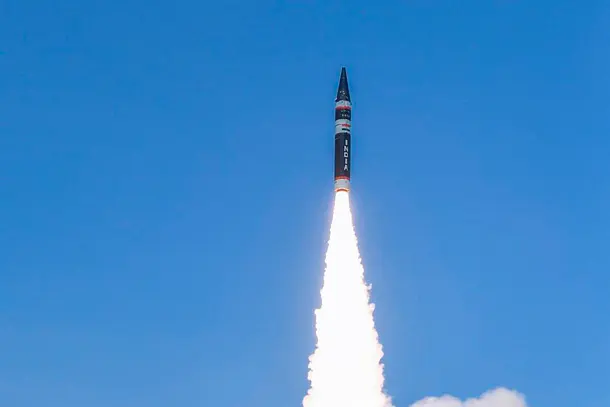
Earlier today, the Agni Prime nuclear-capable ballistic missile underwent a test launch by the Defence Research and Development Organization.
The missile, which can travel between 1,000 and 2,000 kilometres, was created to attack Pakistani objectives. The missile’s claimed range will not enable it to reach all of China’s major cities, the most of which are situated in the nation’s eastern coastal region.
According to reports, the two-stage solid propellant ballistic missile would take the place of the Agni 1 and 2 and Prithvi missiles that were built twenty years ago. Compared to these missiles, which are thought to contain mostly out-of-date technology, it is thought to be more accurate and simple to use.
The great accuracy and manoeuvrability of the missile, according to several experts, may be employed to attack aircraft carriers.
“I believe it to be a maneuvering warhead that can continue to move after reentry based on what I have read. As a result, it can strike moving targets like ships. You may be aware of China’s ability to strike aircraft carriers from a great distance. Systems like [inaudible] give you that kind of capability, “In a recent interview with StratNews Global Editor-in-Chief Nitin Gokhale, Dr. Avinash Chander, a former director-general of DRDO, revealed.
The first known test of the missile took place in June 2021. In December of that year, it underwent a second round of testing.
According to rumours, Agni Prime is the smallest and lightest missile in the Agni series, weighing 50% less than Agni-III.
The missile is constructed of composite material, which has a number of benefits over traditional materials. Composites are stronger, lighter, and provide more design and production flexibility.
The DRDO created some technology for the long-range Agni-IV and Agni-V nuclear-capable ballistic missiles, which are used in the new missile.
Agni Prime has a canisterized terised configuration, which greatly improves the missile’s mobility and facilitates launch.
The warhead can be permanently coupled with the missile in a canisterized design as opposed to needing to be inserted before launch. Because of this, canisterization greatly decreases the amount of time needed to fire a missile and enhances the capacity of the troops to react swiftly to an attack. A missile’s durability and dependability are both improved by canisterization.
When a missile with a nuclear warhead is ready to be canisterized, it is sealed inside a canister and set atop a road-mobile launcher.
When a missile with a nuclear warhead is ready to be canisterized, it is sealed inside a canister and set atop a road-mobile launcher.
India has tested the canisterized Agni-5 intercontinental ballistic missile in the past. The missile’s range is greater than 5,500 kilometres.
By elevating it, a canisterized missile can be fired directly from the canister or cylindrical container in which it is housed.
hhfjggjjj